Search This Blog

Showing posts with label Heritage. Show all posts

Raghurajpur, an emblem of heritage arts and crafts of Odisha!!!


About fifteen km from the revered city of Lord Jagannath, Puri, there is a tiny little hamlet Raghurajpur, nestled on the southern bank of river Bhargavi in the rural heartland of Odisha. Amidst the coconut, palm, and mango groves, this quiet village is a treasure trove for some of the finest heritage art forms of the state. 


Raghurajpur comprises about 130 houses that also function as live workshops divided almost equally on each side, facing each other. There are temples of the local deities in the centre of the village with platforms that provide places for religious celebrations and socializing. 


Raghurajpur was once known as the keepers of Odisha’s ancient Pattachitra art, mainly due to the late Sri. Jagannath Mohapatra (winner of the President of India’s award in 1965) and many artists trained under his guidance. It is fascinating how each household is exclusively involved with some traditional art form or craft, and many are skilled artists! 


Most houses in the village practice the famous heritage art of Odisha, Pattachitra, Tala Pattachitra, (palm leaf engraving), wood carving, stone carving, toys from cow dung, and papier mâché and a few also make Gangifa. These ancient art forms are passed through generations and are said to have been born out of association with the rituals at the Lord Jagganath temple, Odisha's presiding deity. 


Apart from keeping the traditional art forms of Pattachitra and Tala Pattachira alive, the village has also produced some of the finest classical dancers of Gotipua and Odissi, like Sri. Kelucharan Mohapatra. 


The moment one enters the village, one is warmly greeted by the artists and invited to visit their homes. Their tiny homes are a visual treat for art and craft lovers! The entrances, doors, and walls of the houses of Raghurajpur are nothing less than art galleries. The entire village adorns beautiful, intricate paintings that depict stories from Hindu mythology, local deities, flora and fauna of the land, and folktales. Raghurajpur has a fascinating tradition of announcing a wedding in the family by writing the names of a bride and groom on the entrance with some traditional designs.  


One needs to take a languid walk in the village to get a glimpse of the life of artists/craftspeople. The experience is enthralling, as each house has such interesting frescos and art collections that one is overwhelmed with choices. Most villagers are friendly and willing to share their experiences and artistic process, an eye-opening and a great learning experience for the uninitiated. 


Raghurajpur has many National, State, and other prestigious awardees and is trying to change with time while firmly rooted in traditional ways of life and art practices.  


In the year 2000, the traditional art hub of Raghurajpur village was declared a Heritage Village by Indian National Trust for Art and Cultural Heritage (INTACH). Since then, it became more visible on the national and international stage. 


How to go :

Nearest airport/Railway station/ Road  : Bhuvaneshwar , capital of Odisha, about 50 kms from Raghurajpur. Well connected to all the cities of India 

Chamba rumaal; the threaded narratives from Himachal Pradesh !


The expression of feelings through art is a common human trait across civilizations. It is also a complex mixture of social, cultural, aesthetic, psychological, and political spirit of the time and place. The art of adornment is associated with human beings since prehistoric times. With evolution, expression through art became inherent character of various cultures. 

Primitive humankind improvised the stitches used to join animal skins together and started using them also as decoration. And thus began a journey of the art of embroidery. Clothing has been used as a statement for cultural, social, and aesthetic standing. And the art of embroidery has been an intrinsic part of it across cultures. 

In India, each state enjoys the pride of having a rich heritage of unique textile styles, weaves, and embroidery. This article intends to discuss the art form of tradition of pictorial embroidery, known as "Chamba rumaal". 


Origin of Chamba rumaal 

This craft originated,  got refined, and thrived in the erstwhile state of Chamba in the 17 – 18 century AD, around the time when the art of Pahari paintings was at its peak. The image of miniature paintings was transformed into embroidery by women artisans and with time, it became a celebrated craft tradition of Chamba.

"Rumaal" is a Persian word for the handkerchief. And as the name suggests, this visual art refers to embroidering on handkerchiefs; quintessential to the region of undivided Punjab, Himachal Pradesh, and some parts of Kashmir. Unfortunately, now this art form is practiced mostly in Chamba, Himachal Pradesh. 

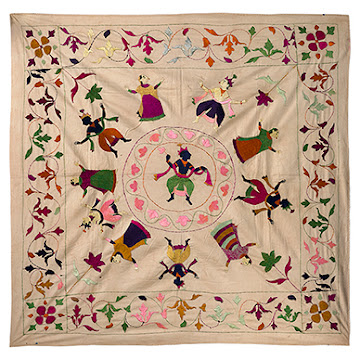
Acclaimed for the fine, double-sided embroidery, the Chamba rumaal is used in multiple conventional ways. These traditional rumaals are made in various shapes and sizes to serve different purposes. A kerchief for men and women, covers for books, for musical instruments, fruit baskets, or gift platters to wallhangings, these rumaals were part of daily life by common people as well the aristocracy.  

The craft of Chamba rumaal is a collaboration between two art forms; the Pahari painting and the fine art of embroidery. In one art form, the painter uses a brush and in another, it is replaced by a needle. In a Chamba rumaal, handmade paper is substituted by fabric and colorful threads replace the beautiful pigments of a Pahari painting. Traditionally, the drawings of the Chamba rumaals were never traced. They were done in freehand style without breaking a line by the skillful hands of the Pahari Painters. Painters invariably guided the embroidery artisans on palettes of silk threads.


History of Chamba rumaal  

The fabric used for the embroidery was handwoven and handspun unbleached muslin, khaddar, or silk. This handicraft thrived due to it being a pivotal part of social customs. The Chamba rumaal was one of the "must-have" items in the dowry. No wedding ceremony would be complete without the gift of finely embroidered Chamba rumaal from the bride's side to the groom and his family. The bride was considered exceptionally meritorious if she had mastered the art of Chamba rumaal embroidery! People loved to flaunt the Chamba rumaals in some form or fashion during social/religious festivities. Usually, the elite class preferred the intricate designs and work on exquisite silk fabric and collected them for aesthetic purposes.

How the Chamba rumaal is made

Creating a Chamba rumaal involves painstaking handwork. This art form demands precision in the skill of double-sided darning (satin stitch carried forward and backward alternately), and satin stitches embroidery on a varied range of delicate cotton fabrics with natural dyed untwisted silk yarns. The primary art, characterized by intricate lines, is traditionally drawn by miniature art experts based on traditional themes. Once the drawing part is over, the embroidery work is usually carried out by accomplished women artisans. The inherent character of the Chamba rumaal embroidery is that both sides of the cloth are stitched simultaneously to fill up space making the design on both sides look uniform, impactful, and identical in content. That is why the technique is known as "do-rukha" (two-faced). The finish of the embroidery is so fine that it is impossible to spot the knots. The rumaal can be viewed from both sides and it looks almost identical.   

In olden times, Pahari painters drew the outlines of the basic picture with a fine brush or charcoal. Sometimes, the embroidery artisans preferred to draw the patterns, figures, and designs themselves. This practice resulted in two uniquely different styles and aesthetics of Chamba rumaal. One elegant and refined in draughtsmanship, and another one, raw, and audacious in treatment.

Colors and motifs of the Chamba rumaal  

Purple, red,  pink, orange, lemon and deep yellow, dark green, parrot green, ultramarine, and Prussian blue, black, and white were the preferred colors. Silver wire known as badla is also noticed on the old Chamba rumaals. Traditionally, the motifs on the Chamba rumaal have been drawn from indigenous tales; the Ramayana and Mahabharata, the Bhagwat Puranas, Nature, and the local life of a community the artisans belonged to. The figures of Krishna along with his Gopis was a common theme. 

Current status of Chamba rumaal 

The art form of Chamba rumaal was practiced till about a hundred years back. With the decline in the patronage from the royal and noble class of the society, the art form slowly became extinct. There are very few artisans left who practice this art form today and despite their measures to revive this embroidery tradition, it is difficult to continue without eager buyers. The only consolation is, after being awarded the Geographical Indication (GI) in 2007, there is a surge in interest from some government bodies and NGOs in its revival. Let's just pray the Chamba rumaal can adapt to contemporary times, receives the much-needed boost, and retain its erstwhile grandeur. 

***All the pictures shared here are taken from Google. 

Cheriyal scroll paintings, a visual memoir of folk art from Telangana


The traditional Cheriayl mask characters, part of a story 
Cheriyal; an artform of painting scrolls for storytelling:

The Indian folk arts are a fascinating blend of excellence in artistry, skills, crafts, cultural and social traditions, and history. They have played a pivotal role in Indian artistic tradition and have been an inherent part of Indian social and cultural life for centuries.


One of the folk art forms of India famous world over is the scroll paintings. Many states in India have traditions of scroll paintings. In earlier times when there were no mediums for communication and entertainment like phone, television, or internet, the scroll paintings served as perfect means for communication, education, and entertainment. Phad scroll paintings from Rajasthan, Pattachitra from Orissa and West Bengal, Jadupatua scroll paintings from Jharkhand, Bihar, and Thangka scroll paintings from Uttarakhand, Sikkim, Ladakh, and Arunachal Pradesh are a few examples of this art form and are a brilliant amalgamation of tradition, culture, and social, religious, and professional ideologies of a given place.  

The Cheriyal scroll paintings from Telangana have a unique character that makes them stand out from other traditional scroll paintings. These scrolls are community-based paintings that depict stories in context with caste professions, rooted in the local heroic legends of particular communities.

Each community would have its band of storytellers/bards. Depending on the profession of the community, the bards would be given titles. For example, Gauda Shettys are the bards for the Gaud community, Chakalipattamvarus are the bards for Chakali or washermen community, Padmasalis are the bards for the weaver community, and so on. 

The artists of Cheriyal scroll paintings painted different stories for different communities. And the wandering minstrels/bards would pick up the scrolls relevant to the community they represented. For example, a bard from the weaver community would invariably take a scroll painting narrating tales from Bhakt Markandeya Purana, as Rishi Markandeya was known to be a seer who wove clothes for Gods. A bard from the fisherman community would pick up scrolls depicting tales from the Mahabharata as the writer of the epic, Maharshi Ved Vyasa was born into a fisherman's family. 


A young artist of traditional Cheriyal scroll painting at an exhibition   
 History of Cheriyal scroll paintings  


For centuries, the bright colors of the Cheriyal scroll paintings have brought folk tales and religious texts to life for the people of Telangana. Cheriyal, the village about a hundred kilometers from Hyderabad was a melting pot of many traditional art forms that were culturally and socially significant and provided employment to the artisans in and around the village. 


The earliest known Cheriyal painting scroll is said to be from 1625 when the Qutub Shahis of Golconda ruled the region of Telangana. The earlier version of this art form was known as Nakshi paintings during that era since it involved precision with fine lines. And the artists were called "Nakshas". While the name of the art form "Nakshi" is derived from the caste of people engaged with it, the scroll paintings are now known as Cheriyal scroll paintings. Sadly, few artists from Cheriyal and those who moved to Hyderabad are the only people practicing this art form albeit, struggling to stay relevant. In 2007, the Cheriyal scroll paintings earned GI (Geographical Indication).


Traditional Cheriyal painting depicting the Dashawatara, from my personal art collection 


Traditionally, the bards/minstrels would travel from one village to another, performing; singing, and dancing to every scene depicted on the scroll pinned in the background. The tales depicted in the scroll paintings would typically be from the Ramayan, Mahabharata, Krishna Leela, and Indian mythology and tales of local legends from various communities to impart moral and social lessons.


The storytellers would carry the scroll paintings with them as they were essential visual aids to go with stories and ballads. A well-constructed scroll painting would last for at least a hundred years and thus would be passed down to the generation of bards/minstrels. Unfortunately, due to some customs observed by the bards, after a certain number of years of usage, the scroll paintings were immersed in holy rivers. And this resulted in the loss of many precious Cheriyal scroll paintings. The only heritage scroll paintings we still have are the ones patronized and collected by the affluent class for aesthetic value. 

The Cheriyal artists also make wooden masks and dolls for traditional stories like “The Katamaraju Katha", an epic Telugu ballad about a war between the chieftain and the king of Nellore which consists of fifty-three characters, all made in the form of human-size dolls which when assembled, narrates popular folklore. Each character also has a story of its own. The storytellers would use those dolls and masks for narrating the story or use them as puppets. 

The art of Cheriyal scroll paintings have remained the same by and large but the unavailability of raw material has pushed the use of technology in some aspects of the craft. 


Traditional Cheriyal masks 

How Cheriyal scroll paintings are made:  


Traditionally, the Cheriyal scroll paintings are made on khadi fabric that is glazed with tamarind seed paste, rice starch, chalk powder, and tree gum. The mix of these ingredients is boiled, filtered with a cotton cloth, and then applied to the khadi canvas. Once the canvas is dried, the priming process is repeated once. After that dries, it is ready for use and the painting process begins. Once the painting of the subject is complete, a border with motifs of leaves and flowers is added to the paintings. 


The scroll paintings are created on bright red backgrounds and invariably follow a color scheme of blue, green, yellow, black, and white. Originally, the colors used in Cheriyal scroll paintings were natural. Black was extracted from lamp soot, white was obtained from river shells or zinc oxide, red and yellow were extracted from stones called Ingligum, skin color from turmeric, and blues from Indigo, and yellow from pevadi stones. These days, the unavailability of natural colors in the region has compelled the artists to procure color powders in bulk from artists from other states. 

Attempt to stay relevant to modern times 

With the advent of mass communication, the demand for these traditional scrolls has waned with time. From a traditional scroll that was three feet high and about fifty feet long with fifty panels, the Cheriyal scroll paintings have reduced to a single panel, suitable for urban homes. The Cheriyal artists are trying to make utility items like key chains, pen holders, wall decor, and small artifacts thus promoting art in whatever form and fashion possible. 

Cheriyal scroll paintings, the carrier of a rich heritage of history and culture are on the verge of extinction. And if we don't support this art form, this artistic expression of a beautiful region will be forgotten forever! 


Bhojpur Shiva temple, an incomplete marvel etched in stone

Perched on a small hillock on the bank of river Betwa about 30 kms from Bhopal city of Madhya Pradesh, stands an incomplete yet majestic Shiva temple; Bhojeshwara Mahadeva. Surrounded by acres of lush green fields, this unique edifice is a testimony to the era gone by and accords peek into cultural significance, techniques of temple architecture, heritage, construction style and practice from 11th century A.D. The Bhojpur Shiva temple is attributed to the legendary King Bhoj Deva of Parmara Dynasty who was not only a great scholar but also patron of arts, renowned author and an avid learner. He reigned the province and the surrounding region from 1010 A.D. to 1055 A.D. 

On the rocky platform near the entrance of the Bhojpur Mahadev temple 

At the very first glimpse of the structure of Bhojpur temple, one feels awestruck! The 106 feet long, 17 feet wide and 17 feet high platform on which the temple is raised, takes one's breath away with its towering size! I was pleasantly surprised by the Braille information kiosk at the entrance of the temple for visually challenged people. (It surely did win some brownie points!) 

View from the slope of serpentine entrance to the temple 

As one walks in from the serpentine entrance towards the temple, the resemblance to the Greek style of temple design immediately comes to mind. There are three levels on which the temple is built; the wide, huge steps leading to a higher level, an open place of worship outside the temple and the main temple. Interestingly unlike the typical Hindu temples where the proportion of sanctum sanctorum is invariably small compared to the space around and at point of complete harmony with over all structure as embodiment of a microcosm of the Universe, at Bhojeshwara temple, the huge Shivalinga contains majority of the Garbhgriha, leaving barely much space around. 

Entrance of the Bhojeshwara temple

The original ceiling of the Garbhgriha of the temple was broken and has been covered with fiber glass sheet in shape of inverted lotus flower just like the original design. The roof is supported by four enormous pillars and twelve piers. The pillars portray intricately carved sculptures of Uma-Maheshwar, Lakshmi-Narayana, Brahma-Savitri, and Sita and Rama.  The door-jambs are adorned with figures of river goddesses Ganga and Yamuna on either sides and Kuber.
A finely polished Shivalinga (the abstract personification of the deity Shiva), 2.35 meters high with a circumference of nearly 7 meters enshrines the square sanctum. Around the linga there are carved columns and above it ornately carved sculpted ceiling. The entire temple is said to be carved out from locally available solid sandstone, a reflection of un-parallel artistry of the time! One can't help wondering how the artisans who built the temple must have raised huge stones of that size and scale.  

The sanctum sanctorum 


Sculptures of River Goddessed Ganga, Yamuna and Kuber 
The fascinating aspect of the Bhojeshwara temple is the that the Shivlinga along with the beautiful Yoni Patta (the biggest I have ever seen) rises to the height of almost 20 feet, making it amongst the tallest Shivalingas in the world! The original architectural designs carved in stone show that the temple complex was aimed on much larger scale and engraved on stone before the construction. In the compound of the temple, one finds engraved stencils on the rocks that explain detailed plans of architectural design for entire temple complex. 
Engraving of the temple construction and design plan 
My heart skipped a beat when I spotted many beautifully carved sculptures; some half-carved statues, unfinished materials and decorative designs with the masons' marks strewn all around, completely neglected in the area of temple complex. 

Engraving on the rocks of temple plans 
There is no clarity on why this temple was left incomplete. However, there are some theories that suggest different versions. One theory says the temple was supposed to be constructed in one night and since the herculean task could not be finished, it remained the way it was. Another school of thought says Bhoja Deva had to rush to Gujarat as the Somanath temple was attacked by Mohammad Gazni and his support was needed. He diverted all the resources thus Bhojeshwar temple remained abandoned.
Sculptures strewn all around, neglected in the temple complex 

Small temple outside sanctum for people to perform pujas 
One may not find the Bhojeshwar Temple in list of popular tourist trails but for lovers of history and archeology, this temple provides perfect material to study examples of medieval, Indian temple architecture.  It is designated as "Monument of National Importance" by the ASI (Archeological Survey of India).
Intricately carved culptures lying in the temple complex 

Temple plans etched on rocks 

Damaged sculpture of Goddess Parvati 


Raghurajpur, an emblem of heritage arts and crafts of Odisha!!!

About fifteen km from the revered city of Lord Jagannath, Puri, there is a tiny little hamlet Raghurajpur, nestled on the southern bank of r...