Search This Blog

Showing posts with label ancient culture. Show all posts

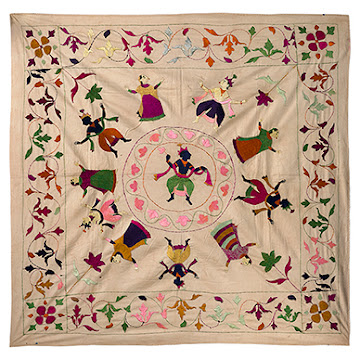
Chamba rumaal; the threaded narratives from Himachal Pradesh !


The expression of feelings through art is a common human trait across civilizations. It is also a complex mixture of social, cultural, aesthetic, psychological, and political spirit of the time and place. The art of adornment is associated with human beings since prehistoric times. With evolution, expression through art became inherent character of various cultures. 

Primitive humankind improvised the stitches used to join animal skins together and started using them also as decoration. And thus began a journey of the art of embroidery. Clothing has been used as a statement for cultural, social, and aesthetic standing. And the art of embroidery has been an intrinsic part of it across cultures. 

In India, each state enjoys the pride of having a rich heritage of unique textile styles, weaves, and embroidery. This article intends to discuss the art form of tradition of pictorial embroidery, known as "Chamba rumaal". 


Origin of Chamba rumaal 

This craft originated,  got refined, and thrived in the erstwhile state of Chamba in the 17 – 18 century AD, around the time when the art of Pahari paintings was at its peak. The image of miniature paintings was transformed into embroidery by women artisans and with time, it became a celebrated craft tradition of Chamba.

"Rumaal" is a Persian word for the handkerchief. And as the name suggests, this visual art refers to embroidering on handkerchiefs; quintessential to the region of undivided Punjab, Himachal Pradesh, and some parts of Kashmir. Unfortunately, now this art form is practiced mostly in Chamba, Himachal Pradesh. 

Acclaimed for the fine, double-sided embroidery, the Chamba rumaal is used in multiple conventional ways. These traditional rumaals are made in various shapes and sizes to serve different purposes. A kerchief for men and women, covers for books, for musical instruments, fruit baskets, or gift platters to wallhangings, these rumaals were part of daily life by common people as well the aristocracy.  

The craft of Chamba rumaal is a collaboration between two art forms; the Pahari painting and the fine art of embroidery. In one art form, the painter uses a brush and in another, it is replaced by a needle. In a Chamba rumaal, handmade paper is substituted by fabric and colorful threads replace the beautiful pigments of a Pahari painting. Traditionally, the drawings of the Chamba rumaals were never traced. They were done in freehand style without breaking a line by the skillful hands of the Pahari Painters. Painters invariably guided the embroidery artisans on palettes of silk threads.

History of Chamba rumaal  

The fabric used for the embroidery was handwoven and handspun unbleached muslin, khaddar, or silk. This handicraft thrived due to it being a pivotal part of social customs. The Chamba rumaal was one of the "must-have" items in the dowry. No wedding ceremony would be complete without the gift of finely embroidered Chamba rumaal from the bride's side to the groom and his family. The bride was considered exceptionally meritorious if she had mastered the art of Chamba rumaal embroidery! People loved to flaunt the Chamba rumaals in some form or fashion during social/religious festivities. Usually, the elite class preferred the intricate designs and work on exquisite silk fabric and collected them for aesthetic purposes.

How the Chamba rumaal is made

Creating a Chamba rumaal involves painstaking handwork. This art form demands precision in the skill of double-sided darning (satin stitch carried forward and backward alternately), and satin stitches embroidery on a varied range of delicate cotton fabrics with natural dyed untwisted silk yarns. The primary art, characterized by intricate lines, is traditionally drawn by miniature art experts based on traditional themes. Once the drawing part is over, the embroidery work is usually carried out by accomplished women artisans. The inherent character of the Chamba rumaal embroidery is that both sides of the cloth are stitched simultaneously to fill up space making the design on both sides look uniform, impactful, and identical in content. That is why the technique is known as "do-rukha" (two-faced). The finish of the embroidery is so fine that it is impossible to spot the knots. The rumaal can be viewed from both sides and it looks almost identical.   

In olden times, Pahari painters drew the outlines of the basic picture with a fine brush or charcoal. Sometimes, the embroidery artisans preferred to draw the patterns, figures, and designs themselves. This practice resulted in two uniquely different styles and aesthetics of Chamba rumaal. One elegant and refined in draughtsmanship, and another one, raw, and audacious in treatment.

Colors and motifs of the Chamba rumaal  

Purple, red,  pink, orange, lemon and deep yellow, dark green, parrot green, ultramarine, and Prussian blue, black, and white were the preferred colors. Silver wire known as badla is also noticed on the old Chamba rumaals. Traditionally, the motifs on the Chamba rumaal have been drawn from indigenous tales; the Ramayana and Mahabharata, the Bhagwat Puranas, Nature, and the local life of a community the artisans belonged to. The figures of Krishna along with his Gopis was a common theme. 

Current status of Chamba rumaal 

The art form of Chamba rumaal was practiced till about a hundred years back. With the decline in the patronage from the royal and noble class of the society, the art form slowly became extinct. There are very few artisans left who practice this art form today and despite their measures to revive this embroidery tradition, it is difficult to continue without eager buyers. The only consolation is, after being awarded the Geographical Indication (GI) in 2007, there is a surge in interest from some government bodies and NGOs in its revival. Let's just pray the Chamba rumaal can adapt to contemporary times, receives the much-needed boost, and retain its erstwhile grandeur. 

***All the pictures shared here are taken from Google. 

Gond painting; the art of visual storytelling through lines, dots and colours!

Some travels linger on our mind long after coming back home. I have just returned from a heritage tour to Madhya Pradesh and am still soaked in overwhelming experience of studying some of the finest architectural expression of Buddhist and Hindu temple art and philosophy, ancient cave paintings and my rendezvous with weavers and tribal artists during the visit to their homes has left me spellbound! 

India, with its diverse customs and traditions from different states is one melting pot that assimilates rich cultural practices. As one goes into interior parts of the country, interesting narratives unfold layer by layer and one can't help but deeply bow to the immense treasure of folk/tribal art forms that are carried forward for centuries through rituals and oral traditions without any documentation. These ancient customs, traditions and art practices are meant to celebrate life in all its hues and are seamless part of everyday life of the artisans. 

Traditional Indian folk/tribal arts are the testimony of rich Indian heritage of centuries. Unfortunately, they are yet to get their due. These art forms rarely get toasted at high profile art events that are reserved for crème de la crème or get the attention, respect and remuneration like contemporary art. There is lot to learn from tribal people. While we often use terms like "sustainable living", "environment conscious" or "mindful living" as fashion statements, the indigenous people have been walking the talk since centuries and it is high time we take some lessons from them not only about life but art and culture too. There is beauty in their rawness, spontaneity, rough lines and  vibrant colors and forms that are born out of continuous dialogue with Nature. But to understand that, one has to be in touch with Nature and have sense of reverence the tribal people practice in their everyday life.  
This article is about tribal art form of painting from Madhya Pradesh, known as Gond. I was fortunate to meet some celebrated, traditional Gond artists at their homes and get a glimpse of their work, life and fascinating stories from their indigenous culture.
   
The Gond painting: Magic of lines, dots and colours!  

Gonds are one of the major tribal communities in India predominantly from Madhya Pradesh, Chattisgadh, Andhra Pradesh and Karnataka and are immensely gifted people carrying on legacy of extraordinary art and crafts. The Gond tribe is closely connected with Nature and their art is as pristine as the lush green land they hail from. 
The history of Gond tribe tells how over period of time, with Mughals conquering their lands and later with Britishers plundering their source of income, support for the tribe’s oral traditions started dwindling. Forced to live life of penury, the Gonds were compelled to take labour work but the stories that were passed down through generations remained in their hearts and found voice in visual medium through auspicious designs on their huts, entrances, walls and floors. Like most indigenous tribes, Gonds are blessed with great sense of aesthetics and strongly believe that perceiving/viewing a good image brings in great luck.
The Gond paintings were originally made with help of natural colours obtained from coloured soil, minerals, charcoal, cow dung, plants and flowers. With the change in surface on which painting is done and natural colours becoming bit difficult to procure, the Gond tribe has changed the medium to acrylic colours, paper and canvas. However, their themes still remain the same; folklore, daily life, creation myths, festivals, celebrations, major events of life, harvesting, legends and Gods, Goddesses and demons. The narrative is beautifully rendered using dots, lines, dashes, curves and spectacular colours with perfect harmony and balance. It is amazing how the style changes with each artist displaying inherent signature genre with her/his own vocabulary. Once the subject is decided, the outline is drawn and then filled with dots, strokes and vivid colours adding interesting perspective to the imagery.
Presenting here some of the artists I had honour to meet during my recent heritage tour to Madhya Pradesh. 
Award winning Gond artist, Durgabai Vyam. at her residence in Bhopal  

Durgbai Vyam, sister of legendry Gond artist Jangarhsing Shyam has a distinct “mahura” style of her own, which is inspired by jewelry. Her paintings are about simple, rural daily life while her husband likes to draw “dhigna” which is traditionally geometrical in nature and drawn on all four sides of the painting. Their immensely gifted daughter is a force to reckon with in contemporary art world. A graduate from NIFT Banglore, Roshni has a very refreshing perspective on importance of indigenous visual traditions and has unique colour palette that can cater to contemporary as well as traditional art lovers.    
Gond painting by late Gond artist,  Jangarhsingh Shyam's daughter Japani 

Like her celebrated late father, the legendry Gond artist Jangarhsing Shyam, Japani works with bold colours that delve in themes like trees; significance of Nature, creation myths, flora and fauna, Bara Dev, animals and birds and abstract concepts like dreams. Her imagery and rendition of the concepts is simply mind blowing!
Family members of  legendary artist Jangarhsingh Shyam
Mayank Shyam, son of pioneering artist Jangarhsingh Shyam has created his own beautiful style of Gond painting. His forms are comparatively very different (androgynous) and large, his strokes bold yet fluid, colours tweaked and one can almost see the context evolved with his visual grammar that is result of exposure to the contemporary art world and a shift in socio-economic dynamics. 
The best thing of meeting all members of Jangarhsingh Shyam’s family together was understanding how each artist is uniquely different when it comes to  interpretation, ideation and rendition despite using the same traditional techniques of the art form! 

A playful work, depicting what happens to people after consumption of liquor, by Sukhnandi Shyam 
Sukhnandi Vyam’s Gond paintings have fascinating fluidity. His themes are playful, his colours and strokes have lyrical quality to them. Sukhnandi also sculpts and works extensively with multiple mediums like clay, canvas, metal and wood. His wooden sculptures won him great recognition with Madhya Pradesh State Government award in 2002.

Venkatraman Singh Shyam with his wife and son 
Venkat Raman singh Shyam’s work is vibrant and mystical. There are interesting stylistic influences and one can see how he is finding his space in world of modern Indian art. Awarded the Rajya Hasta Shilpa Puraskar by the government of Madhya Pradesh in 2002, his paintings are about legendary fables associated with Gods and demons, beasts and reptiles, recurrent themes from everyday social life. Venkat Singh Shyam’s colours are bold, imagery fascinating and language both traditional and contemporary. He bemoans lack of respect for environment and his concern is evidently visible in his themes and talks.

Gond work by Venkatraman Singh Shyam 

Depiction of the tales from the folklore being explained by Sukhnandi Shyam 

A scene from  village, work by Sukhnandi Shyam 

Gond painting by Nankusia Shyam, wife of Jangarhsing Shyam 

Work by Sukhnandi Shyam 

Painting by Gond artist Mayank  Shyam 

Gond painting by Nankusia Shyam, wife of Jangarhsing Shyam

Gond paintings by artist Sukhnandi Shyam 

 Gond painting by Nankusia Shyam, wife of Jangarhsing Shyam

Gond painting in ink by Nankusia Shyam, wife of Jangarhsing Shyam 

Gond work by Mayank Shyam

Gond painting in ink by Nankusia Shyam, wife of Jangarhsing Shyam

Gond painting by Nankusia Shyam, wife of Jangarhsing Shyam

Gond artist Mayank Shyam showing work at his Bhopal residence 

With Gond artist Sukhanandi Shyam 

Gond work by Mayank  Shyam 

Gond paintings by artist Mayank  Shyam 

Raghurajpur, an emblem of heritage arts and crafts of Odisha!!!

About fifteen km from the revered city of Lord Jagannath, Puri, there is a tiny little hamlet Raghurajpur, nestled on the southern bank of r...